Showing posts with label Marketing. Show all posts

Tuesday, 25 June 2019

What ‘Calibra’ mean for Marketers?

Facebook announced it is launching a financial subsidiary in 2020 called Calibra that will include a digital wallet offered as a standalone app and built into WhatsApp and Messenger. The digital wallet will enable global users to make financial transactions using Libra, the newly formed currency powered by Blockchain technology backed by Facebook and a number of leading financial, technology and venture capital organizations, including Mastercard, Uber, PayPal and Andreessen Horowitz. Libra will be governed by the Libra Association, formed to promote adoption of the currency and developer platform.

Facebook is still in the early stages of this effort. Addressing privacy concerns, the company has said it will not share user account information or financial data with a third party without a user’s consent. Facebook also said Calibra’s user data would not be used for ad targeting on Facebook’s platforms. That doesn’t mean there won’t be implications for an advertiser. Even without using Calibra’s data for ad targeting purposes, Facebook expects its move into the cryptocurrency market will have a positive impact on ad revenue.
Marketers are paying attention to the cross-border payment capabilities Facebook’s Calibra will offer. It’s a way for Facebook to bring e-commerce into developing countries, where they don’t have stable currencies or means to pay. Whether or not Facebook will be able to drive global e-commerce within its apps via Calibra depends entirely on the success of the Libra cryptocurrency it is helping to develop.

Data privacy issues, customer trust issues, regulatory uncertainty, the absence of China and many other strict Cryptocurrencies regulated countries, other competing but more mature ‘good enough’ technologies are all great barriers that Facebook needs to overcome. Creating a way for worldwide users to engage with brands — and purchase from them regardless of their geographic location — could dramatically impact Facebook’s business model and further cement its dominance as a social platform. But, it’s not going to be smooth sailing for Facebook in the coming months.

Much is riding on the success of the Libra cryptocurrency for Facebook. But, should it succeeds, marketers are ready for the added e-commerce and customer experience possibilities it could provide. It’s a way Facebook can keep users inside of its platforms — Instagram, Facebook, WhatsApp — longer, while, at the same time, increasing conversion rates for e-commerce advertisers because of the expectation will be that consumers will be checking out using the Libra coins, and it will be all one seamless experience.

Monday, 22 April 2019

Cross-Domain Analytics Tracking

The process of implement cross-domain tracking can be tricky and if not done correctly can fail or cause inaccurate information to be collected in the client’s analytic tools. There are many blog posts and columns to configure cross-domain tracking, however, what these posts don’t contain is why a business should or should not implement cross-domain tracking. What are the benefits of cross-domain tracking and are there any risks associated with it?

What is Cross-domain tracking?

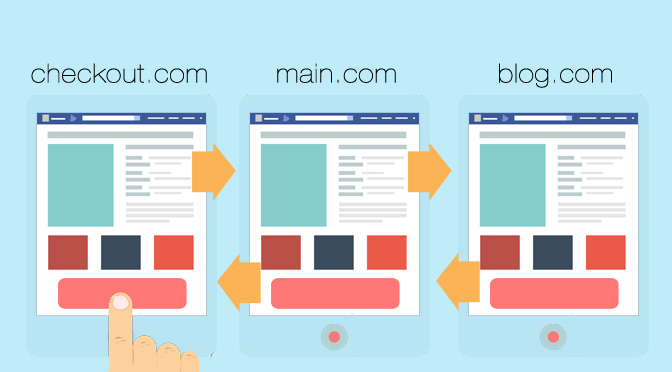
Cross-domain tracking makes it possible for Analytics to see sessions on two related sites as a single session. Cross-domain allows you to view a website visitor’s session as they navigate from one domain to another as part of a single customer journey from the point of acquisition to conversion.
When and when not to implement Cross-domain tracking?

Implementing a cross-domain tracking solution isn’t the answer to poorly configured website. First problem statement is - “If you go to our site with domain.com everything is fine, but you also get there with www.domain.com and everything is also fine, but as you navigate the site, sometimes a user gets the www and sometimes they don’t.” The answer is yes cross-domain tracking can help, but you’re better off having your admin fix it with one line in the .htacess file to either show the www or not show it every time.

Another problem statement is - “We have a few sites domainA.com, domainB.com and domainC.com and want to see how many people navigate between them.” This may sound like a perfect reason to implement cross-domain tracking, but when you dig a bit deeper and ask “Do you have links between your sites?” or “Are the sites related in some specific way?” and you get the answer “No!”, then what they are asking for isn’t cross-domain tracking, but rather “session stitching” which is far more complex to implement.

What cross-domain tracking, is truly intended for is connecting the data flow between related sites. For example, perhaps you have all your marketing landing pages on a sub-domain of www1.domain.com and clicking on the call to action takes the user to a different domain (perhaps to complete a form i.e., ecommerce.domain.com) and once they’ve completed this task they are then returned to your public site of www.domain.com with additional conversion opportunities. In this customer journey, a visitor would encounter three domains and as a business owner, you need to know which ads drove conversions and potentially if running A/B testing on landing pages which landing pages yield conversions. This is the perfect scenario to implement cross-domain tracking.

Perhaps you operated multiple domains in support of a common target audience that does link to each other and the services promoted on each of them. Once again, this is a perfect reason to implement cross-domain tracking as part of a roll-up analytics report.

While a bit of a stretch, if your organization operates multiple websites that aren’t linked together you can through some custom reporting and the use of Attribution Modeling and Multi-Channel reporting, view if a user visited associated websites (including which ones) before converting on the final one. This last option can be extremely tricky to implement, expensive and fraught with holes that may limit the reliability of the data. However, to some people, a bit of data is better than no data at all.

Saturday, 23 March 2019

How to find New Audiences for Awareness Campaigns?

You’ve tried custom intent audience; custom affinity audience and now you’re having trouble scaling your managed placements. You know you want to grow your audiences but are leery of testing broader targeting options. What audiences should you test next for your display campaigns in Google Ads? The Audience Insights tool in the Google Ads Audience Manager is a great resource for display advertising. Let’s take a look at where to find this tool and how you can utilize the information to find new audience combinations to test.

Click the tools menu in the overhead navigation of Google Ads. In the drop-down menu, find “Audience Manager” under the Shared Library Column. Once you’re in the Audience Manager, click on “Audience Insights” on the left-hand side of the page. By default, the audience we can review first is an all Users audience.

No matter which audience is the default option that shows up, you can also select which country you want to use to review the audience data. Now advertisers can see the top in-market and affinity audiences your selected audience falls under. But you don’t have to stick to all users. You can change the “Audience to get insights on” option to a variety of audiences you have in your Google Ads account. This will help you learn more about the users in each of your base audiences.
Users in different base audiences are going to fall under different in-market and affinity audiences. When crafting your campaign and ad group structure, utilize this information in the Audience insights tool to find the best, new audiences to test your new campaigns. Use different ad copy to speak to different audiences. You can’t review a base audience in the Audience insights tool unless they have 1000 users.

If the default audiences in Google ads are not working for you, consider creating those audiences with longer date ranges to be able to analyze your current users. If your account has built up enough users to view a variety of audience data, try and find patterns between the audiences. If you see certain in-market and affinity audiences show up in several audiences you’re pulling data, you should probably test those first.

If you’re looking for new audiences to try for your display campaigns, the Audience Insights tool will give you new ideas to use based upon the current audiences with your account. Not only you can use the tool to test new audiences, but you can use it to see if the in-market and affinity audience data changes over time. User behavior will change. Your target audience might change. Check back every once in a while to see if you should switch up your display targeting at any point. The audience insight tool is there with the information you need.

Saturday, 9 February 2019

Impact of 5G on Marketing and Advertising

5G is gearing up to launch later this year. The coming of next-gen 5G wireless transmission will be a big deal for marketers. Verizon has launched a 5G-enabled home broadband service, AT&T has started 5G service in a dozen cities and 5G networks are expected to be available by mid-2019. With data rates from 1 to 10 gigabits/second – up to 100 times faster than 4G LTE and a major decrease in latency, 5G could alter a lot of the existing digital landscape.
End of Cable - Cable connections & set-top boxes could become irrelevant. If you get a new, large TV, for instance, it might pick up all the HD and 4K programming you want from the air wirelessly. This would totally disrupt the cable and Internet Service Provider industry because the fixed wire infrastructure would no longer be necessary to deliver fast Internet and hundreds of TV channels, and it would similarly disrupt the ad-buying and -serving infrastructure built around it. But it also means something more profound for marketers: any surface with a 5G wireless transceiver can become a high-resolution screen, and an outlet for the most intelligent computing service available.

A 5G-enhanced media environment, offers more ad inventory opportunities as super-fast wireless connectivity means high-end screens can be located anywhere. It also could dramatically change the kind of messaging marketers and advertisers do. The biggest marketing impact of 5G will be that consumers will have actual voice conversations with mobile devices, not just issue a few voice commands and interact at other times via thumb-typing or screen-touching. Mobile marketing could become entirely oriented toward voice conversations.

But it’s not just data repositories that may have to be redesigned to handle massive demand. Advertising infrastructures will also have to be re-invented. Present-day programmatic technologies aren’t built for the demands of a system that delivers ads up to a hundred times faster. The industry needs to prepare for 5G in other ways as well, such as updating creative specs on ad formats and file sizes.

Tuesday, 30 January 2018

Book Review: Predictably Irrational

When it comes to making decisions in our lives, we think we’re in control. We think we’re making smart, rational choices. But are we? From paying for coffee to losing weight, and buying a car to choosing a romantic partner, Author explains how to break through these systematic patterns of thought to make better, more financially sound, decisions. Predictably Irrational is not simply a fascinating read; it has the power to change the way we interact with the world – one small decision at a time. In the current economic crisis it is an invaluable tool that no person should be without.

Not only do we make astonishingly simple mistakes every day, but we make the same type of mistakes. We consistently overpay, underestimate and procrastinate. We fail to understand the profound effects of our emotions on what we want and we overvalue what we already own. Yet these misguided behaviors are neither random nor senseless. They’re systematic and predictable.
For instance in first chapter - “The Cost of Relativity”, the author tells us about the how prices of different commodities are kept relative to each other and keeping a costlier product next to a product which costs less can make the cheaper product look like a bargain and thus help the product sell.

In fourth chapter, Dan talks about the cost of social norms and how to keep the delicate balance between social norms and market norms. He also talks about how measuring every exchange in terms of money can be a big mistake. And why relationships building with clients are really important and helps build goodwill while the same thing can backfire badly and leave a bad reputation in market if not handled properly with lots of analogies and examples about the same.

From a startup perspective this book is immensely useful, whether it comes to pricing your products/services or Marketing them, this book gives you insights you never had and results you never expected to get. This book is medium paced and very sticky which makes it very difficult for a habitat reader to leave it mid-way.

Overall, I loved reading it and will revisit my notes when I notice such irrational behaviors either from myself or from others. Do read if human psychology, behavioral theories, motivation principles, biases etc. are topics that intrigue you. Take your time to read this book; skimming through it may not be effective.

Tuesday, 1 September 2015

Mela Marketing: The new Buzz

Fairs (Melas) have always been an integral part of the Indian lifestyle. It is difficult to find a person in the country who has never visited a fair or came across a Bollywood flick with a typical 1970s storyline of family tribute and re-union, all happening in Mela. It is these marketing honchos who have bought fairs to the center-stage by using them as a platform to market products.

The roots of such Mela Marketing are not just desi by their means. In USA, for example, in 2001 the sports drink giant ‘Gatorade’ tried to cash in on the theme of Thanksgiving and invested Millions in marketing its drink during the Thanksgivings fairs across the country. Later, in 2008, they even came up with a TV commercial Replay which was also built around a match that has always been played on the eve of Thanksgiving.
Not that Indian company was alien to this, but till now, Mela marketing simply was seen as a social service for rural folk. But this year Melas have seen huge investments in product marketing campaigns. In the Kumbh Mela, the element of novelty was 26 brands marketing their products using the Mela as the focal point of their campaign. For instance, Dettol marketed itself with a tagline, “Kumbh me snaan ek baar, Dettol mein Snaan baar-baar”. Boroline came up with “Kumbh se Punya Kamao, Boroline se Achchi Twacha Banao”.

Fairs are a good platform for direct promotion of brand. These fairs attract huge chunks of people from different strata of the society at one place for the longest period of time. Another example was the Dabur Campaign for its mosquito repellent ‘Odomos’. The interesting thing is, while Urban Melas like the Trade Fair, which attract highs of between 2.5-4 Lakh people on their weekend days, get hundreds of advertisers; events like Kumbh Mela still churn up at best only 26 Advertisers.

Melas advertising remains great point of sale immediacy conversion and would work only in relatively low priced FMCG products or services. For non-FMCG sectors, it’s clearly not such a promising deal currently as most of the masses at these Melas do not have intent to purchase durables during their visits. Nobody will buy a car or home in a Mela. But still they can think about it if there is an advertisement.

Wednesday, 4 February 2015

Metro to Marketing Train

Advertising to increase by 12.7% in the coming year, GroupM said in a report. From Digital to print advertising, businesses are fighting to give their ads and spending in crores to attract customers. Now, Companies are targeting Metro train coaches in cities to promote their business. I was travelling in one of the Yellow line metro and whole Train was covered with advertisement of E-commerce giant Amazon India.

It was very difficult for me to understand Where the Train was last up to. Everything was covered with ads from Amazon. Even the interior ad space was covered with E-commerce ads. The Delhi metro covers 190.03km across six lines and ferries close to 260,000 passengers on a daily basis. Part of it is underground and part overground. DMRC runs 216 trains with 1,282 coaches. According to a report, 8 Million people used its services in 2013-14. Presently, most of the Metro trains have become marketing trains.
Earlier companies fight for ads on TV and newspaper, now they are fighting for ads on Metro. It might a situation in India when companies will promote their business on Indian Railway, which is one of the longest networks in the World. In Delhi, after IndiaMart, Amazon, and Political parties, Myntra will be seen advertising on Delhi Metro coaches. Paytm and Snapdeal are also in discussions to do the same. Advertisers may around Rs. 25 lakh to wrap up six to eight coaches of the metro for a month i.e. on average Rs. 4 Lakh for a coach.

The companies are also hoping for similar opportunities in Bengaluru and Chennai. Mumbai smaller Metro has trains sporting ads from BigBasket, UltraTech Cement, and Oxigen, an electronic payment service. Consumer goods and mobile phones companies may also join the queue. Delhi Metro has awarded exclusive rights for displaying advertising materials including pictures, printed material, electronic media, smart posters, and visual displays. The concept is very popular in Singapore, Bangkok, Hongkong, Dubai, and the US.

This is very catchy and effective medium. This leads to increase in consumer base, more downloads of mobile apps, and increase in revenue. Even, people who are not aware of it know about companies. It becomes easy for sales person to reach out in a local market and sell products because of awareness of companies and products. What if Metro trains are also used to increase awareness of Social causes? Display ads of Government campaigns may increase awareness and it will last long. With changing scenarios of marketing in last two years, huge amount of money will flow in market and there will be more marketing trains.